Stevan Armakovic

- Physicist with expertise in the computational modeling of materials and molecules. - Assistant Professor at the University of Novi Sad, Faculty of Sciences, Department of physics. - Board President of the Association for the International Development of Academic and Scientific Collaboration (www.aidasco.org) - 130 papers in journals with impact factors, ~2000 citations (Web of Science, Scopus), h-index 25 (Web of Science, Scopus) - Founder of the atomistica.online project

CPUs for Quantum Mechanical Calculations on Budget (in 2025)

Welcome to atomistica.online Articles & Tutorials CPUs for Quantum Mechanical Calculations on Budget (in 2025) Modern ab initio and semi-empirical electronic-structure codes exploit vector instructions and many cores to reduce simulation time. Codes such as xTB, ORCA, Gaussian, and Quantum ESPRESSO perform millions of floating-point operations to construct Fock matrices, diagonalize Hamiltonians, and evaluate gradients. […]

CPUs for Quantum Mechanical Calculations on Budget (in 2025) Read More »

Mini PCs and NUCs

Welcome to atomistica.online Articles & Tutorials Mini PCs and Intel NUCs – Compact Powerhouses for Modern Computing Personal computers no longer have to be big beige towers. Over the past two decades, the demand for small-footprint machines has given rise to an entire category of “mini PCs.” These compact computers use low-power components and omit

Mini PCs and NUCs Read More »

Synopsis Acquires Ansys

Welcome to atomistica.online Articles & Tutorials Synopsys Acquires Ansys: A New Era for Engineering and Atomistic Modeling In July 2025, Synopsys, one of the world’s leading electronic design automation (EDA) companies, officially completed its $35 billion acquisition of Ansys, a global pioneer in physics-based engineering simulation. The deal, years in the making and involving regulatory

Synopsis Acquires Ansys Read More »

OMol25 and UMA

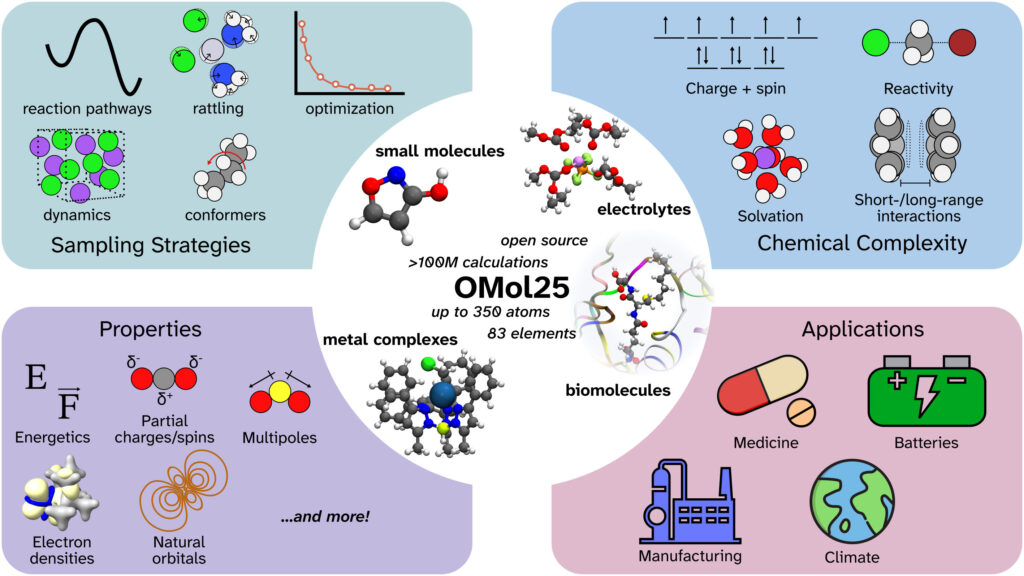
Welcome to atomistica.online Articles & Tutorials Open Molecules 2025 and Universal Model for Atoms OMol25 and UMA: A New Era for Atomistic Modeling When people think of Meta, social media likely comes to mind. But behind the scenes, Meta’s Fundamental AI Research (FAIR) team has been reshaping scientific research, including computational chemistry and materials science.

OMol25 and UMA Read More »

What is LIMS

Welcome to atomistica.online Articles & Tutorials What Is LIMS and How Can It Transform Your Laboratory Operations? Understanding LIMS In today’s fast-paced and data-driven world, laboratories (either academic or commercial) are under increasing pressure to handle complex workflows efficiently while maintaining accuracy and compliance. Laboratory Information Management Systems (LIMS) have become an essential tool to

What is LIMS Read More »

Common mistakes in molecular modeling involving B3LYP functional

Welcome to atomistica.online Articles & Tutorials Common mistakes in molecular modeling involving B3LYP functional If you find this article useful, please consider supporting the development of atomistica.online by citing: Stevan Armaković and Sanja J. ArmakovićATOMISTICA.ONLINE – WEB APPLICATION FOR GENERATING INPUT FILES FOR ORCA MOLECULAR MODELING PACKAGE MADE WITH THE ANVIL PLATFORMMolecular Simulation, 49 (1)

Common mistakes in molecular modeling involving B3LYP functional Read More »

ORCA job launcher and monitoring app

Welcome to atomistica.online Articles & Tutorials Simplifying molecular modeling: Introducing the ORCA launcher and job monitor application from atomistica.online Welcome to the tutorial about the GUI application for running and monitoring of ORCA calculations. This tutorial will guide you how to use our application to avoid using command prompt when it is necessary to run

ORCA job launcher and monitoring app Read More »

Citing density functionals

Welcome to atomistica.online Articles & Tutorials Citing density functionals Lately, while reviewing manuscripts for journals with impact factor, we have noticed an increasingly negative trend – authors don’t provide citations for density functionals, basis sets, software packages used for calculations, etc. If beginners read a paper where, for example, density functional is not cited, they

Citing density functionals Read More »